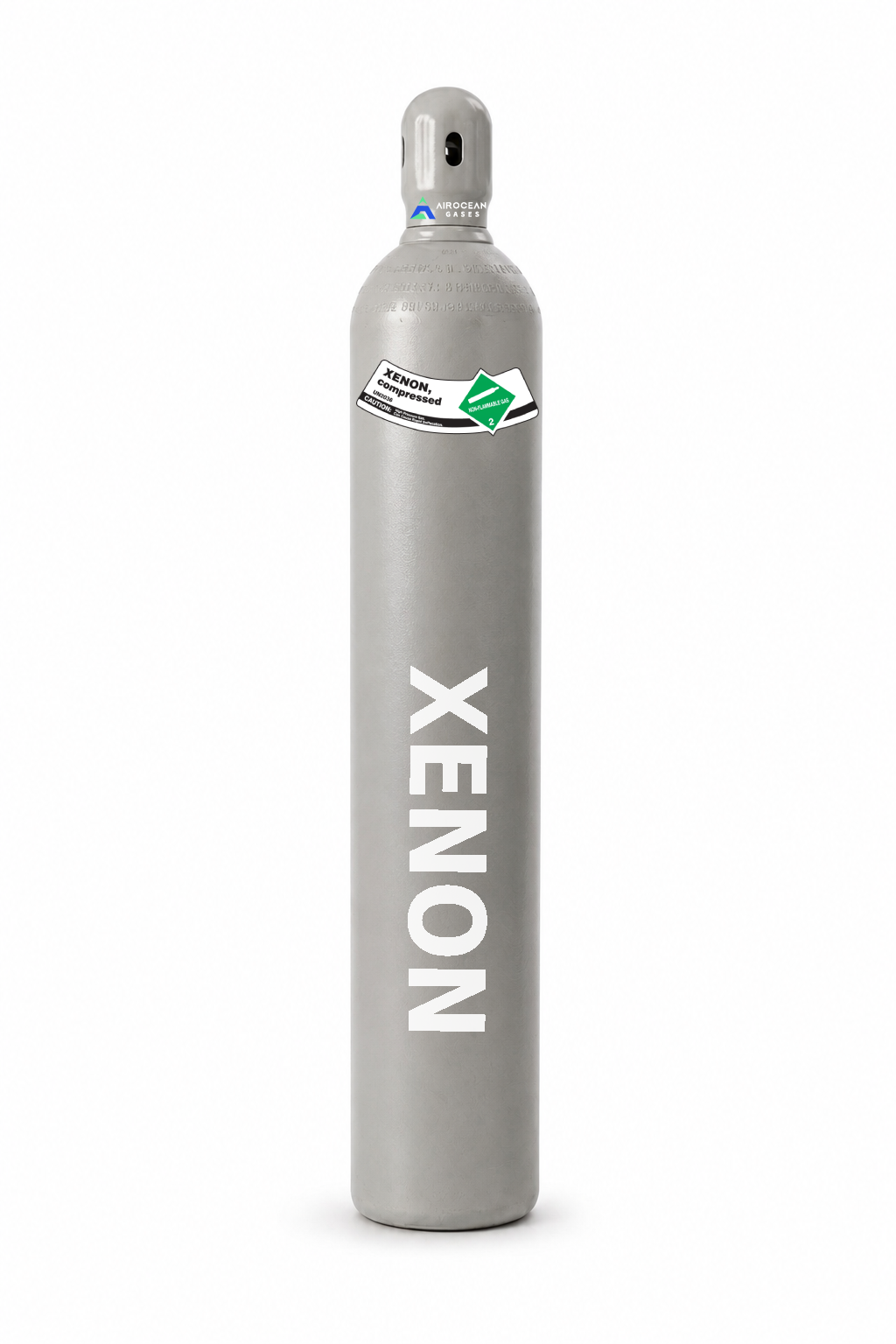
Xenon Cas 7440-63-3 for sale
Xenon Cas 7440-63-3 for sale
Buy Xenon Cas 7440-63-3
Xenon is a chemical element; it has symbol Xe and atomic number 54. It is a dense, colorless, odorless noble gas found in Earth’s atmosphere in trace amounts.[16] Although generally unreactive, it can undergo a few chemical reactions such as the formation of xenon hexafluoroplatinate, the first noble gas compound to be synthesized.[17][18][19]
Xenon is used in flash lamps[20] and arc lamps,[21] and as a general anesthetic.[22] The first excimer laser design used a xenon dimer molecule (Xe2) as the lasing medium,[23] and the earliest laser designs used xenon flash lamps as pumps.[24] Xenon is also used to search for hypothetical weakly interacting massive particles[25] and as a propellant for ion thrusters in spacecraft.[26]
Naturally occurring xenon consists of seven stable isotopes and two long-lived radioactive isotopes. More than 40 unstable xenon isotopes undergo radioactive decay, and the isotope ratios of xenon are an important tool for studying the early history of the Solar System.[27] Radioactive xenon-135 is produced by beta decay from iodine-135 (a product of nuclear fission), and is the most significant (and unwanted) neutron absorber in nuclear reactors.[28]
History
Xenon was discovered in England by the Scottish chemist William Ramsay and English chemist Morris Travers on July 12, 1898,[29] shortly after their discovery of the elements krypton and neon. They found xenon in the residue left over from evaporating components of liquid air.[30][31] Ramsay suggested the name xenon for this gas from the Greek word ξένον xénon, neuter singular form of ξένος xénos, meaning ‘foreign(er)’, ‘strange(r)’, or ‘guest’.[32][33] In 1902, Ramsay estimated the proportion of xenon in the Earth’s atmosphere to be one part in 20 million.[34]
During the 1930s, American engineer Harold Edgerton began exploring strobe light technology for high speed photography. This led him to the invention of the xenon flash lamp in which light is generated by passing brief electric current through a tube filled with xenon gas. In 1934, Edgerton was able to generate flashes as brief as one microsecond with this method.[20][35][36]
In 1939, American physician Albert R. Behnke Jr. began exploring the causes of “drunkenness” in deep-sea divers. He tested the effects of varying the breathing mixtures on his subjects, and discovered that this caused the divers to perceive a change in depth. From his results, he deduced that xenon gas could serve as an anesthetic. Although Russian toxicologist Nikolay V. Lazarev apparently studied xenon anesthesia in 1941, the first published report confirming xenon anesthesia was in 1946 by American medical researcher John H. Lawrence, who experimented on mice. Xenon was first used as a surgical anesthetic in 1951 by American anesthesiologist Stuart C. Cullen, who successfully used it with two patients.[37
Xenon is one of the rarest stable elements in Earth’s atmosphere, present at only 87 parts per billion by volume — earning it the designation “the golden gas” among rare gas specialists. Discovered in 1898 by Ramsay and Travers, its name derives from the Greek word for “stranger.” Its exceptional density, high atomic cross-section, and chemical inertness make it uniquely valuable across some of the most demanding technological applications on earth and beyond.
In aerospace, xenon is the propellant of choice for ion propulsion systems (Hall-effect and gridded ion thrusters), powering attitude control and station-keeping for commercial satellites and deep-space probes. Its superior specific impulse — compared to conventional chemical propellants — translates directly into payload mass savings and extended mission life. Xenon has been selected for major space programs including NASA’s Dawn and ESA’s SMART-1 missions.
In semiconductor manufacturing, high-purity xenon is employed in excimer laser systems for deep-ultraviolet photolithography and as a process gas in plasma etch chambers. In medicine, xenon serves as an inhaled anesthetic with a favorable safety profile: it requires no hepatic metabolism, produces rapid emergence, and offers neuroprotective properties under investigation for cardiac and neurological applications. Airocean Gases supplies Grade 5.5 (99.9995% UHP+) and Grade 6.0 (99.9999% Research Grade) xenon to meet the strictest industry requirements.
- Royalchem
- 7440-63-3
| Product Name | High-Purity Xenon Gas (Xe) 99.9995% Purity Grade: 5N5 Ultra-High Purity Product Form: Compressed Gas |
| CAS Number | 7440-63-3 |
| Symbol and Atomic Number | Xe; Atomic Number 54 |
| Molar Mass | 131.293 g/mol |
| Product Image |  |
| Typical Purity Specification | Xenon Assay: ≥99.9995% Hydrogen (H2): ≤0.2 ppm Oxygen + Argon (O2 + Ar): ≤1.0 ppm Nitrogen (N2): ≤2.0 ppm Carbon Monoxide (CO): ≤0.1 ppm Carbon Dioxide (CO2): ≤0.05 ppm Methane (CH4): ≤0.05 ppm Krypton (Kr): ≤0.05 ppm Moisture (H2O): ≤1.0 ppm Nitrous Oxide (N2O): ≤0.05 ppm Hexafluoroethane (C2F6): ≤0.1 ppm |
| Reference Physical Properties | Appearance: Colorless, odorless gas Chemical Characteristics: Inert, nonflammable noble gas Boiling Point: Approximately −108.1°C Relative Characteristics: Heavier than air and may accumulate in confined or low-lying areas |
| Key Applications | Semiconductor and Electronics: Used in selected high-aspect-ratio plasma etching and other specialized plasma processes where gas purity and trace impurities require close control. Suitability depends on the equipment, process recipe, and impurity specification. Lighting and Photonics: Used in high-intensity discharge lamps, automotive and aviation lighting, photographic flash lamps, ultraviolet light sources, and selected excimer-laser gas systems. Spacecraft Ion Propulsion: Used as a propellant in satellite ion thrusters and Hall-effect thrusters because of its high atomic mass and favorable ionization characteristics. Research Applications: Used in high-energy physics, dark-matter detection, spectroscopy, and other research systems requiring high-purity noble gases. |
| Packaging and Supply Confirmation | Supplied in cylinders suitable for high-pressure gas service and the applicable transport requirements. Cylinder water capacity, fill quantity, filling pressure, valve connection, cylinder material, return arrangement, and available quantity are subject to the quotation, order, and actual supply plan. Please provide the destination, end use, and required valve standard when requesting a quotation. |
| Storage and Handling | Xenon is nonflammable, but a high-concentration release can displace oxygen and cause asphyxiation. Secure cylinders upright, keep valve-protection devices in place, and store in a cool, dry, well-ventilated area away from heat and direct sunlight. Use pressure-control and piping equipment rated for the cylinder pressure and install backflow prevention where appropriate. Test oxygen levels before entering any area where oxygen deficiency may be present. |
| Transport Information | Common transport classification: UN 2036; Proper Shipping Name: Xenon, compressed; Hazard Class 2.2, nonflammable and non-poisonous gas; no packing group normally assigned. Final shipping name, labels, cylinder requirements, and declarations must be confirmed against the SDS for the supplied batch, filling condition, packaging, transport mode, route, and destination regulations. |
Basic Info.
Product Description

Product Parameters

Product Name | Xenon |
Molecular Formula | Xe |
CAS | 7440-63-3 |
EINECS No. | 231-172-7 |
Grade | Electron Grade, Industrial Grade |
Place Of Origin | Jiangsu, China |
Purity | 99.999%- 99.9999%- |
Hazard Class | 2.2 |
Molecular Weight | 131.29 |
UN | 2036 |
Boiling Point(ºC) | (-108.13°C) |
Packing Detail | Cylinder: 50L(DOT) Valve:CGA580 |


In the future, we will continue to adhere to the values of “just and right, harmony and bright scenery”, and make vigorous efforts to further contribute to the development of industrial and semiconductor industries.
Exhibition


Product packaging
 FAQ
Q : How much is your product?
Q : How about the delivery time?
Q : How to insure the aquality of your products?
Q : How do you ensure the stability of your supply?


Medical Grade Pure Xenon Gas for Sale – 99.999% Purity – Alibaba.com
Medical Grade Pure Xenon Gas for Sale. High purity, nonflammable, odorless. Ideal for industrial, medical anesthesia, …Read more
Rare Gas Cas No. 7440-63-3 Xe Electronics Medical Grade 99999 …
Rare Gas Cas No. 7440-63-3 Xe Electronics Medical Grade 99999 Xenon Gas Price. AGEM offers high purity xenon gas for plasma …Read more
Buy Xenon Gas (Xe) — 5.5N UHP+ & 6N Research Grade – Airocean …
Buy high-purity Xenon gas — 5.5N (99.9995%) UHP+ and 6N (99.9999%) Research Grade — for aerospace propulsion, …Read more
Xenon 99.99 , Messer CANGas 7440-63-3 – MilliporeSigma
Xenon is a colourless and odourless rare gas that is heavier than air. Applications include use as a filling gas for lamps (halogen …Read more
7440-63-3 – XENON – Sale from Quality Suppliers – Guidechem
Explore the best XENON price and the most comprehensive XENON supplier on Guidechem. Find the chemical you need and …Read more
Xenon Gas 5N5 | Semiconductor & Ion Propulsion | Royalchem
Royalchem supplies 5N5 Xenon Gas (Xe), CAS 7440-63-3, for semiconductor plasma processes, photonics, ion propulsion and …Read more
Xenon 99.99 , Messer CANGas 7440-63-3 – MilliporeSigma
Xenon is a colourless and odourless rare gas that is heavier than air. Applications include use as a filling gas for lamps (halogen …Read more
99.999% Purity Electron Grade CAS 7440-63-3 Xenon Gas Best Price
Xenon is a key component in neon-based excimer laser gas mixtures used to generate laser light for precise photolithograph and to …Read more
Industrial Grade CAS 7440-63-3 99.9999% Purity Xenon Gas
A: We have two factories with excellent equipment and high quality control system to ensure the supply of products. Enter between …Read more
CAS 7440-63-3 | XENON – Guidechem Chemical Network
Explore the comprehensive XENON price list, compare and choose the best XENON supply. Synonyms, Application, FAQs, etc. Find …Read more
Reviews
There are no reviews yet.