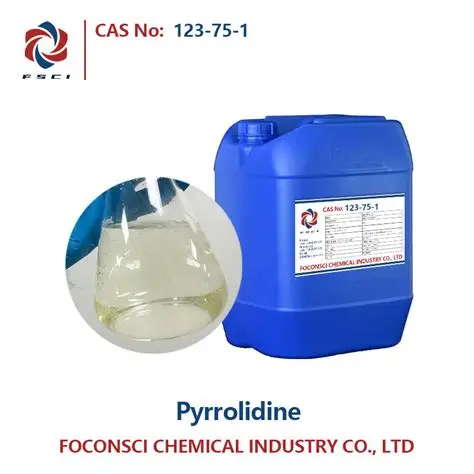
Pyrrolidine tetrahydropyrrole (CAS 123-75-1) for sale
Pyrrolidine tetrahydropyrrole (CAS 123-75-1) for sale
Order Pyrrolidine tetrahydropyrrole (CAS 123-75-1)
Order Pyrrolidine tetrahydropyrrole (CAS 123-75-1)
Buy Pyrrolidine Tetrahydropyrrole Online
Buy Pyrrolidine Tetrahydropyrrole Online . Pyrrolidine Dithiocarbamate, Ammonium Derivative, also known as Pyrrolidinedithiocarbamate, can be used for several biochemical applications like metal chelation. Ungraded products supplied by Spectrum are indicative of a grade suitable for general industrial use or research purposes and typically are not suitable for human consumption or therapeutic use.
Names Order Pyrrolidine Tetrahydropyrrole Online
Ammonium Pyrrolidinecarbodithioate ; 1-Pyrrolidinecarbodithioic Acid Ammonium Salt
Chemical Properties Buy Pyrrolidine Online
| Density | 0.8±0.1 g/cm3 |
|---|---|
| Boiling Point | 89.5±8.0 °C at 760 mmHg |
| Melting Point | -63 °C |
| Molecular Formula | C4H9N |
| Molecular Weight | 71.121 |
| Flash Point | 2.8±0.0 °C |
| Exact Mass | 71.073502 |
| PSA | 12.03000 |
| LogP | 0.37 |
| Vapour density | 2.45 (vs air) |
| Vapour Pressure | 58.6±0.2 mmHg at 25°C |
| Index of Refraction | 1.428 |
| Stability | Stable; flammable. Incompatible with strong acids, strong oxidizing agents |
CHEMICAL IDENTIFICATIONRTECS NUMBER : UX9650000
CHEMICAL NAME : Pyrrolidine
CAS REGISTRY NUMBER : 123-75-1
BEILSTEIN REFERENCE NO. : 0102395
LAST UPDATED : 199701DATA ITEMS CITED : 11
MOLECULAR FORMULA : C4-H9-N
MOLECULAR WEIGHT : 71.14
WISWESSER LINE NOTATION : T5MTJ
Safety Information Pyrrolidine Tetrahydropyrrole
| Symbol | GHS02, GHS05, GHS07 |
|---|---|
| Signal Word | Danger |
| Hazard Statements | H225-H302 + H332-H314 |
| Precautionary Statements | P210-P280-P305 + P351 + P338-P310 |
| Personal Protective Equipment | Face shields; full-face respirator (US);Gloves; Goggles; multi-purpose combination respirator cartridge (US);type ABEK (EN14387) respirator filter |
| Hazard Codes | F:Flammable;C:Corrosive; |
| Risk Phrases | R11;R20/21/22;R35 |
| Safety Phrases | S16-S26-S36/37/39-S45-S33 |
| RIDADR | UN 1922 3/PG 2 |
| WGK Germany | 2 |
| RTECS | UX9650000 |
| Packaging Group | II |
| Hazard Class | 3 |
| HS Code | 2933990090 |
Synonyms Pyrrolidine Tetrahydropyrrole
| Tetrahydro pyrrole |
| Pyrrolidine [UN1922] [Flammable liquid] |
| Pyrrole, tetrahydro- |
| Tetramethyleneimine |
| Pyrrolidinepyrrolidine |
| Azolan |
| EINECS 204-648-7 |
| 1-Azacyclopentane |
| T5MTJ |
| Tetrahydropyrrole, Tetramethyleneimine |
| MFCD00005249 |
| Pyrrolidine |
| Tetrahydropyrrole |
Packing Factory Pyrrolidine Tetrahydropyrrole
· 1kg/aluminium foil bag, with two plastic bags inside.
· 25kg/fiber drum, with two plastic bags inside.
Size:ID 42cm*H52cm,0.08m3/drum;
Net Weight:25kgs Gross Weight:28kgs.
Factory Price Pyrrolidine liquid, Tetrahydropyrrole, Azolan wholesale from china
wholesale Tetrahydro pyrrole
Factory price Pyrrolidine [UN1922] [Flammable liquid]
Order Pyrrole, tetrahydro- china
Tetramethyleneimine supplier
Pyrrolidinepyrrolidine dealer
Azolan EINECS 204-648-7
1-Azacyclopentane T5MTJ
Tetrahydropyrrole MFCD00005249
wholesale Pyrrolidine Tetrahydropyrrole
Wholesale CAS 123-75-1
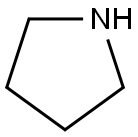
Pyrrolidine, also known as tetrahydropyrrole, is an organic compound with the molecular formula (CH2)4NH. It is a cyclic secondary amine, also classified as a saturated heterocycle. It is a colourless liquid that is miscible with water and most organic solvents. It has a characteristic odor that has been described as “ammoniacal, fishy, shellfish-like”.[4] In addition to pyrrolidine itself, many substituted pyrrolidines are known.
Production and synthesis
Industrial production
Pyrrolidine is prepared industrially by the reaction of 1,4-butanediol and ammonia at a temperature of 165–200 °C and a pressure of 17–21 MPa in the presence of a cobalt- and nickel oxide catalyst, which is supported on alumina.[5]
1-Azacyclopentane, Buy MFCD00005249, buy Pyrrolidine liquid online, buy Pyrrolidine Online, Buy T5MTJ, Buy Tetrahydropyrrole wholesale, EINECS 204-648-7, Factory price Pyrrolidine [UN1922] [Flammable liquid], Order Pyrrole, Order wholesale Pyrrolidine, Pyrrolidinepyrrolidine dealer, Pyrrolidine Online, sell Azolan wholesale, tetrahydro- china, Tetramethyleneimine supplier, Wholesale CAS 123-75-1, wholesale Tetrahydro pyrrole
Pyrrolidine
- CAS No.
- 123-75-1
- Chemical Name:
- Pyrrolidine
- Synonyms
- TETRAHYDROPYRROLE;Pyrrolidin;FEMA 2523;FEMA 3523;PRD;Azolidine;Prolamine;Tetrapyrrole;AZACYCLOPENTANE;Tetrahydropyrrol
- CBNumber:
- CB9852978
- Molecular Formula:
- C4H9N
- Molecular Weight:
- 71.12
- MOL File:
- 123-75-1.mol
- MSDS File:
- SDS
- Modify Date:
- 6/23/2026 4:59:16 PM
| Melting point | -63 °C |
|---|---|
| Boiling point | 87-88 °C/760 mmHg (lit.) |
| Density | 0.852 g/mL at 25 °C (lit.) |
| vapor density | 2.45 (vs air) |
| vapor pressure | 128 mm Hg ( 39 °C) |
| refractive index | n20/D 1.443(lit.) |
| FEMA | 3523 | PYRROLIDINE |
| Flash point | 37 °F |
| storage temp. | Store below +30°C. |
| solubility | water: miscible |
| form | Liquid |
| pka | 11.27(at 25℃) |
| color | Colorless to Almost colorless |
| Odor | at 0.10 % in propylene glycol. ammoniacal animal egg amine |
| PH | 12.9 (100g/l, H2O, 20℃) |
| explosive limit | 1.6-10.6%(V) |
| Odor Type | ammoniacal |
| biological source | synthetic |
| Water Solubility | Miscible with alcohol, ether, chloroform and water. |
| Specific Heat Capacity | Cp(liquid): 2.2 J/(g·K), at 25℃ |
| Sensitive | Air Sensitive |
| Merck | 14,8015 |
| JECFA Number | 1609 |
| BRN | 102395 |
| Henry’s Law Constant | 4.2×100 mol/(m3Pa) at 25℃, Amoore and Buttery (1978) |
| Dielectric constant | 8.3000000000000007 |
| Stability | Stable; flammable. Incompatible with strong acids, strong oxidizing agents. |
| InChI | 1S/C4H9N/c1-2-4-5-3-1/h5H,1-4H2 |
| InChIKey | RWRDLPDLKQPQOW-UHFFFAOYSA-N |
| SMILES | C1CCNC1 |
| LogP | 0.22 at 25℃ |
| Surface tension | 30.11mN/m at 293.15K |
| CAS DataBase Reference | 123-75-1(CAS DataBase Reference) |
| NIST Chemistry Reference | Pyrrolidine(123-75-1) |
| EPA Substance Registry System | Pyrrolidine (123-75-1) |
SAFETY
Risk and Safety Statements
| Symbol(GHS) |     GHS02,GHS05,GHS06,GHS08 | |||||||||
|---|---|---|---|---|---|---|---|---|---|---|
| Signal word | Danger | |||||||||
| Hazard statements | H330-H301-H314-H370-H225 | |||||||||
| Precautionary statements | P501-P260-P270-P240-P210-P233-P243-P241-P242-P271-P264-P280-P284-P370+P378-P308+P311-P303+P361+P353-P301+P330+P331-P363-P301+P310+P330-P304+P340+P310-P305+P351+P338+P310-P403+P233-P403+P235-P405 | |||||||||
| PPE | Faceshields, Gloves, Goggles, type ABEK (EN14387) respirator filter | |||||||||
| Hazard Codes | F,T,C | |||||||||
| Risk Statements | 11-22-23-34-35-20/21/22-20/22-R35-R20/21/22-R11 | |||||||||
| Safety Statements | 16-26-36/37/39-45-33-S45-S36/37/39-S26-S16 | |||||||||
| RIDADR | UN 1922 | |||||||||
| WGK Germany | 2 | |||||||||
| RTECS | UX9650000 | |||||||||
| F | 34 | |||||||||
| Autoignition Temperature | 653 °F | |||||||||
| TSCA | TSCA listed | |||||||||
| HS Code | 2933 99 80 | |||||||||
| HazardClass | 3 | |||||||||
| PackingGroup | II | |||||||||
| Storage Class | 3 – Flammable liquids | |||||||||
| Hazard Classifications | Acute Tox. 4 Inhalation Acute Tox. 4 Oral Eye Dam. 1 Flam. Liq. 2 Skin Corr. 1A | |||||||||
| Hazardous Substances Data | 123-75-1(Hazardous Substances Data) | |||||||||
| Toxicity | LD50 orally in Rabbit: 433 mg/kg | |||||||||
| REACH Registrations | Active | |||||||||
| Limited Quantities | 1.0 L (0.3 gallon) (liquid) | |||||||||
| Excepted Quantities | Max Inner Pack (30g or 30ml) and Max Outer Pack (500g or 500ml) | |||||||||
| Order Pyrrolidine tetrahydropyrrole (CAS 123-75-1) Order Pyrrolidine tetrahydropyrrole (CAS 123-75-1) Order Pyrrolidine tetrahydropyrrole (CAS 123-75-1) Order Pyrrolidine tetrahydropyrrole (CAS 123-75-1) |
|
Pyrrolidine price More Price(24)
| Manufacturer | Product number | Product description | CAS number | Packaging | Price | Updated | Buy |
|---|---|---|---|---|---|---|---|
| Sigma-Aldrich(India) | W352316 | Pyrrolidine FG | 123-75-1 | 1SAMPLE | ₹5141.88 | 2022-06-14 | Buy |
| Sigma-Aldrich(India) | P73803 | Pyrrolidine 99% | 123-75-1 | 5ML | ₹1948.5 | 2022-06-14 | Buy |
| Sigma-Aldrich(India) | W352316 | Pyrrolidine FG | 123-75-1 | 1KG | ₹7588.33 | 2022-06-14 | Buy |
| Sigma-Aldrich(India) | P73803 | Pyrrolidine 99% | 123-75-1 | 100ML | ₹2100.05 | 2022-06-14 | Buy |
| Sigma-Aldrich(India) | P73803 | Pyrrolidine 99% | 123-75-1 | 500ML | ₹9915.7 | 2022-06-14 | Buy |
Pyrrolidine Chemical Properties,Uses,Production
Chemical Properties
Pyrrolidine appears as a colorless to pale yellow liquid with an ammonia-like odor. It is infinitely miscible with water and conventional organic solvents such as methanol, acetone, ether, and chloroform. It acts as a lachrymator.
Chemically, pyrrolidine behaves like a secondary amine in every respect. For example, it undergoes Leuckart –Wallach and Mannich reactions and is readily converted into an enamine. In the presence of a catalyst, such as platinum at 360°C or rhodium at 650°C, pyrrole is formed. In the presence of a copper catalyst, N-methylpyrrolidone is converted into N-methylpyrrolidine.
Physical properties
Pyrrolidine has a penetrating amine-type odor, reminiscent of ammonia and piperidine. It is easy to turn yellow when exposed to light or humid air, easily soluble in water and ethanol. It is nauseating and diffusive.
Occurrence
Reported found in beer, bread, wheat bread, salmon caviar, fish, milk, leaves and stalks of celery, Camembert cheese, Limburger cheese, Russian cheeses, tilsit cheese, other cheeses, caviar, raw fatty fish, beer, Finnish whiskey, white wine, red wine, coffee, radish, malt, roasted peanut, sweet corn and roasted barley.
Uses
Pyrrolidine is a flammable alkaline liquid that undergoes reactions typical of secondary amines. It is used to prepare pesticides and rubber accelerators and as a chemical intermediate (usually the hydrochloride form) in the pharmaceutical industry. There is relatively limited industrial exposure to this material.
Application
Pyrrolidine is a heterocyclic compound used as a building block in the synthesis of wide range of pharmaceutical compounds, namely matrix metalloprotein inhibitors (MMPIs) and aminopeptidase N inhibitors (APNIs). It has been used for the synthesis of N-benzoyl pyrrolidine from benzaldehyde via oxidative amination. It may be used as a catalyst for the synthesis of N-sulfinyl aldimines from carbonyl compounds and sulfonamides.
Pyrrolidine can also be used to synthesize:
Taddol-pyrrolidine phosphoramidite, a ligand for rhodium-catalyzed [2+2+2] cycloaddition of pentenyl isocyanate and 4- ethynylanisole.
H,4 PyrrolidineQuin-BAM (′PBAM′), a selective catalyst for the aza-Henry addition of nitroalkanes to aryl aldimines.
1,2,3,3a,4,9-Hexahydropyrrolo[2,1-b]quinazoline by reacting with o-aminobenzaldehyde.
Preparation
Pyrrolidine is formed by reduction of pyrrole. Via overall 5-endo-trig cyclizations of homoallylic tosylamides. Pyrrolidine can be produced from butanediol and ammonia, e.g., over an aluminum thorium oxide catalyst at 300°C or over a nickel catalyst at 200°C and 20 MPa under hydrogenation conditions. It can also be produced from THF and ammonia over aluminum oxide at 275-375°C.
Definition
ChEBI: Pyrrolidine is a cyclic amine whose five-membered ring contains four carbon atoms and one nitrogen atom; the parent compound of the pyrrolidine family. It is a saturated organic heteromonocyclic parent, a member of pyrrolidines and an azacycloalkane. It is a conjugate base of a pyrrolidinium ion.
General Description
Pyrrolidine is a saturated heterocycliccompound having one nitrogenatom in a five-membered ring. It is a colorless to pale yellow liquid with an ammonia-like odor. It is found in certain plants andthe ring structure is present in manyalkaloids. Flash point 37°F. Density 0.85 g / cm3. Vapors heavier than air. Produces toxic oxides of nitrogen during combustion.
Air & Water Reactions
Highly flammable. Very soluble in water.
Reactivity Profile
Tetrahydro pyrrole neutralizes acids in exothermic reactions to form salts plus water. May be incompatible with isocyanates, halogenated organics, peroxides, phenols (acidic), epoxides, anhydrides, and acid halides. May generate hydrogen, a flammable gas, in combination with strong reducing agents such as hydrides. An explosion occurred when a mixture of Tetrahydro pyrrole, benzaldehyde, and propionic acid was heated in an attempt to form porphyrins.
Hazard
Flammable, dangerous fire risk. Toxic by ingestion and inhalation.
Health Hazard
The acute toxicity of pyrrolidine is moderateon test animals. It is somewhat less toxicthan pyrrole. The vapors are an irritant tothe eyes and respiratory tract. The liquid iscorrosive to the skin. Contact with the eyescan cause damage. The oral LD50 value inrats is 300 mg/kg, while the inhalation LC50value in mice is 1300 mg/m3/2 h (NIOSH1986).
Fire Hazard
Flammable/combustible material. May be ignited by heat, sparks or flames. Vapors may form explosive mixtures with air. Vapors may travel to source of ignition and flash back. Most vapors are heavier than air. They will spread along ground and collect in low or confined areas (sewers, basements, tanks). Vapor explosion hazard indoors, outdoors or in sewers. Runoff to sewer may create fire or explosion hazard. Containers may explode when heated. Many liquids are lighter than water.
Safety Profile
Poison by ingestion and intravenous routes. Moderately toxic by inhalation. Dangerous fire hazard when exposed to heat or flame; can react vigorously with oxidizing materials. To fight fire, use alcohol foam, CO2, dry chemical. When heated to decomposition it emits hghly toxic fumes of NOx.
Purification Methods
Dry pyrrolidine with BaO or sodium, then fractionally distil it, under N2, through a Todd column (p 11) packed with glass helices. [Beilstein 20 H 159, 20 I 36, 20 II 79, 20 III/IV 2072, 20/1 V 162.]
Pyrrolidine Preparation Products And Raw materials
Raw materials
Preparation Products
Pyrrolidine 99 123-75-1 – MilliporeSigma
Pyrrolidine has been used for the synthesis of N -benzoyl pyrrolidine from benzaldehyde via oxidative
CAS RN 123-75-1 | Fisher Scientific
From benchtop discovery to process development and scale-up, Sigma Organics solutions are built to meet the needs of synthetic …
Buy Pyrrolidine CAS 123-75-1 Manufacturer | Supplier – Mikemchem
Mikem specializes in manufacturing Pyrrolidine CAS 123-75-1, offering multiple chemical product grades with reliable quality, prompt …
Pyrrolidine (CAS 123-75-1) | Glentham Life Sciences
Buy GK9009 – Pyrrolidine (123-75-1) online from Glentham Life Sciences, a manufacturer and supplier of fine chemicals. View …
- CAS RN: 123-75-1
- MDL Number: MFCD00005249
- EC Number: 204-648-7
- Storage Temperature: +20°C
Pyrrolidine | 123-75-1 – ChemicalBook
Jun 23, 2026 · Pyrrolidine (CAS 123-75-1) information, including chemical properties, structure, melting point, boiling point, density, …
- Boiling point: 87-88 °C/760 mmHg (lit.)
- Melting point: 63 °C
- Density: 0.852 g/mL at 25 °C (lit.)
- vapor density: 2.45 (vs air)
Pyrrolidine FG 123-75-1 – MilliporeSigma
Find documentation for the products that you have recently purchased in the Document Library.
Shop pyrrolidine | Wholesale & Retail | Sarchem Labs
Buy pyrrolidine. Highly reliable, consistent in quality, and at a reasonable cost. We are the best chemical supply and research partner …
Pyrrolidine | 123-75-1 – ChemicalBook
Jun 23, 2026 · ChEBI: Pyrrolidine is a cyclic amine whose five-membered ring contains four carbon atoms and one nitrogen atom; …
Pyrrolidine CAS 123-75-1 Tetrahydropyrrole – fscichem.com
Pyrrolidine, also known as Tetrahydropyrrole, is a cyclic secondary amine with a special smell. It is a colorless to light yellow liquid …
Pyrrolidine 123-75-1 | Tokyo Chemical Industry Co., Ltd. (APAC)
Pyrrolidine | C4H9N | CID 31268 – structure, chemical names, physical and chemical properties, classification, patents, literature, …
Deep dive into Buy Pyrrolidine tetrahydropyrrole (CAS 123-75-1)
- pyrrolidine 99
- aldrich pyrrolidine 99
- pyrrolidine 99 synthesis
- p73803 pyrrolidine
1-Azacyclopentane, Buy MFCD00005249, buy Pyrrolidine liquid online, buy Pyrrolidine Online, Buy T5MTJ, Buy Tetrahydropyrrole wholesale, EINECS 204-648-7, Factory price Pyrrolidine [UN1922] [Flammable liquid], Order Pyrrole, Order wholesale Pyrrolidine, Pyrrolidine Online, Pyrrolidinepyrrolidine dealer, sell Azolan wholesale, tetrahydro- china, Tetramethyleneimine supplier, Wholesale CAS 123-75-1, wholesale Tetrahydro pyrrole
Reviews
There are no reviews yet.